
The Tally
The boy with the barrow had told her twice to mind the grey cart, and the third time Ione minded it so thoroughly that she walked into a lamp-post.
"That's all right, miss," said the boy, who was a rabbitfolk lad of about sixteen with ears like two folded napkins and a trunk lashed to his barrow that weighed nearly as much as he did. "Everyone does it on Low Road. It's the bang. You listen for it, and you forget your feet."
"What bang?" said Ione.
There was a pause of perhaps four seconds. Then the street trembled very slightly, like a table when someone sits down hard in the next room; a flock of pigeons rose off a roof ahead of her, all together, in a clapping grey sheet; and from somewhere behind a high brick wall on the right-hand side there rose a thin white plume of smoke, which stood for a moment against the blue evening sky, and bent over, and thought better of it.
"That one," said the boy comfortably. "It's only a small one. Come along, miss. It's the yellow house."
It was the third day of Sunpeak, a Windwhisper, warm and gold, and a little after four in the afternoon. The long summer light lay down Low Road like a carpet; in the gutters the water ran clear; at the open doors the women sat on their steps with their sleeves rolled and their feet in the sun. On the right-hand side stood a great grey workshop with a chimney like a giant's finger and a slate board hung at its gate, on which someone had chalked in a careful square hand, DAYS SINCE LAST ACCIDENT: and then, in a tidier hand, a large round 0. On the left, across the cobbles and at a crooked angle to its gate, stood a low wide house of yellow brick, patched here and there with brick of another yellow, with a crooked chimney, a window-box of marigolds, and a door that stood open on the warm smell of bread.
Ione Fairlie stopped on the pavement with her satchel in both hands.
She was twenty-three. She was a small slight pale young woman with brown hair pinned up in a knot, in a plain dark gown with a clean white collar, and she had a certificate from the Academy of Letters in the satchel and a speech in her head, which she had been saying over to herself since she crossed the High Road. It began, I am very glad to be here, and it went on from there in a firm and cheerful manner for nearly a minute. She had said it to the looking-glass. She had said it to the cat. She could not now remember a word of it.
"You'll want to go in, miss," said the boy kindly. "They don't bite. It's only the one that bites, and he's three."
He had hardly finished the sentence when the door was filled.
It was filled by a very tall, spare woman in her fifties, in a coarse brown apron and a cloth tied over a heavy grey knot of hair, with sleeves rolled to the elbow over a pair of strong brown arms that were dusted with flour to the wrist. She had a lined face and a mouth like a ruled line and a pair of perfectly clear grey eyes, and in her right hand, quite naturally, as a sergeant carries his staff, she held a long wooden spoon.
"Miss Fairlie," she said.
"Mistress Lili," said Ione, and found that the speech had gone altogether, and that what was left was only the plain truth. "I'm afraid I've never done this."
"No," said Lili. "I didn't suppose you had." She considered her for a moment from the pinned hair down to the dusty shoes. "Wipe your feet."
The kitchen was a long low room with a vast iron stove at one end and a scrubbed table down the middle, and at the table, in two rows, with their elbows on the wood and their spoons halfway to their mouths, sat twenty children.
They stopped eating. They looked at her. It was an extremely thorough look: it began at the top and went down to the shoes, and it came back up again, very slowly, to the face; and Ione, who had once been stared at by a great hall full of people in a place of green fire and who had thought at the time that nothing could be worse, discovered that she had been quite wrong. That had been a crowd. This was twenty separate individual opinions.
There was a tall boy at the end of the table, near the door, with scorched cuffs and the long raw wrists of fourteen. There was a severe girl of twelve with a thick plait over one shoulder and her arms folded. There was a boy of nine with a gap in his front teeth that whistled when he breathed; and a very small boy of five, with a spoon in his fist and porridge all down his front, who looked at her with enormous and perfectly impartial eyes. Down the table, two girls of eight with the same freckles whispered into each other's ears. At the far end sat a thin silent boy of seven with a stub of candle in a jam jar on the bench beside him, which was not lit.
"This is Miss Fairlie," said Lili. "She's the teacher. She'll be sleeping over the kitchen, and she'll begin on Treesong, and you will be civil. Marit."
"Yes, Mistress."
"Tell her where to put her trunk."
"The runner's got it," said the severe girl. She got down from the bench and came round the table, and stood in front of Ione with her chin up, and looked at her; it was a look that took in the satchel, the collar, the dust and the very slight tremor in the hand, and set them all, with some care, on a scale. "Are you a real one?"
"I beg your pardon?"
"A real one. A real teacher. Mr. Corbet said he was, and he was only a clerk. And Miss Anselm said she was, and she hadn't a certificate." Marit nodded at the satchel. "Have you got a certificate?"
"I have," said Ione.
"Can I see?"
She took it out. It was a large cream sheet with a green seal, and the words Academy of Letters across the head of it in a flourish like a flock of birds; and Marit read it, the whole of it, with her lips moving very slightly on the long words, and handed it back.
"It's real," she said to the room. "It's got a seal."
There was a small murmur, like a breeze in a field. Then the boy with the gap in his teeth said, with great interest, "How long are you going to last?"
"Dunny," said Lili.
"I only asked."
"He's only asking," said Marit, in the tone of a woman who has learned to be fair to her brothers. "It's the Tally. Come and look."
The Tally was on the larder door.
It was the first thing Ione saw when she came into the kitchen, where every teacher before her had taught between the porridge and the washing-up, and the last that she noticed, because she had taken it for a part of the paint. It was a plain deal door, painted green a long time ago, and across it from top to bottom, in thick white chalk in a dozen different childish hands, ran a list.
MR. CORBET. 2 DAYS. (The frog.)
MISS ANSELM. 1 DAY. (Left by the window. The Workshop.)
MR. PIKE. 4 DAYS.
MRS. HALE. 6 DAYS. (Cried.)
MISS POMFRET. 9 DAYS. (The Great Boom.)
Beneath it was a ruled line, and below the line a blank space about a yard deep.
"Nine days is the record," said Marit. She said it as other people say the names of kings. "Miss Pomfret did it. She would have done more, only the Great Boom took out the kitchen window and the stove and she went home to her mother. Mr. Pike was the nicest. He had a whistle." She looked at Ione sideways. "Mrs. Hale cried all the time. She wasn't bad."
"And Mr. Corbet?"
"It was the frog," said Dunny, with deep satisfaction. "He didn't like frogs."
"That's five," said Ione. Her voice, she was pleased to hear, came out perfectly steady. "And I'm to be the sixth."
"Seventh," said Dunny.
"There were only five on the door."
"There was a lady one afternoon," said Marit, "who came to see what it was like. She didn't count. She had a hat." She turned her whole severe young face up to Ione and the tall boy at the table, and the twins, and the smallest boy, whose spoon had at last arrived at its destination, all seemed to lean a little, as plants do towards a window. "We don't mind," said Marit, very fairly. "We don't mind if you go. We only keep the numbers."
At that moment there was another bang.
It was a larger one than the first. The jam jar rattled on the bench; the spoons jumped; a little dust sifted from the ceiling into the porridge, and nobody so much as lifted a head. At the end of the table Dunny pushed back his hair with a grubby hand and announced, in the tone of a man naming a bird:
"That's the Windwhisper one."
"They've a different one for every day," said Marit. "You get used to it. Mistress, may I show her the room?"
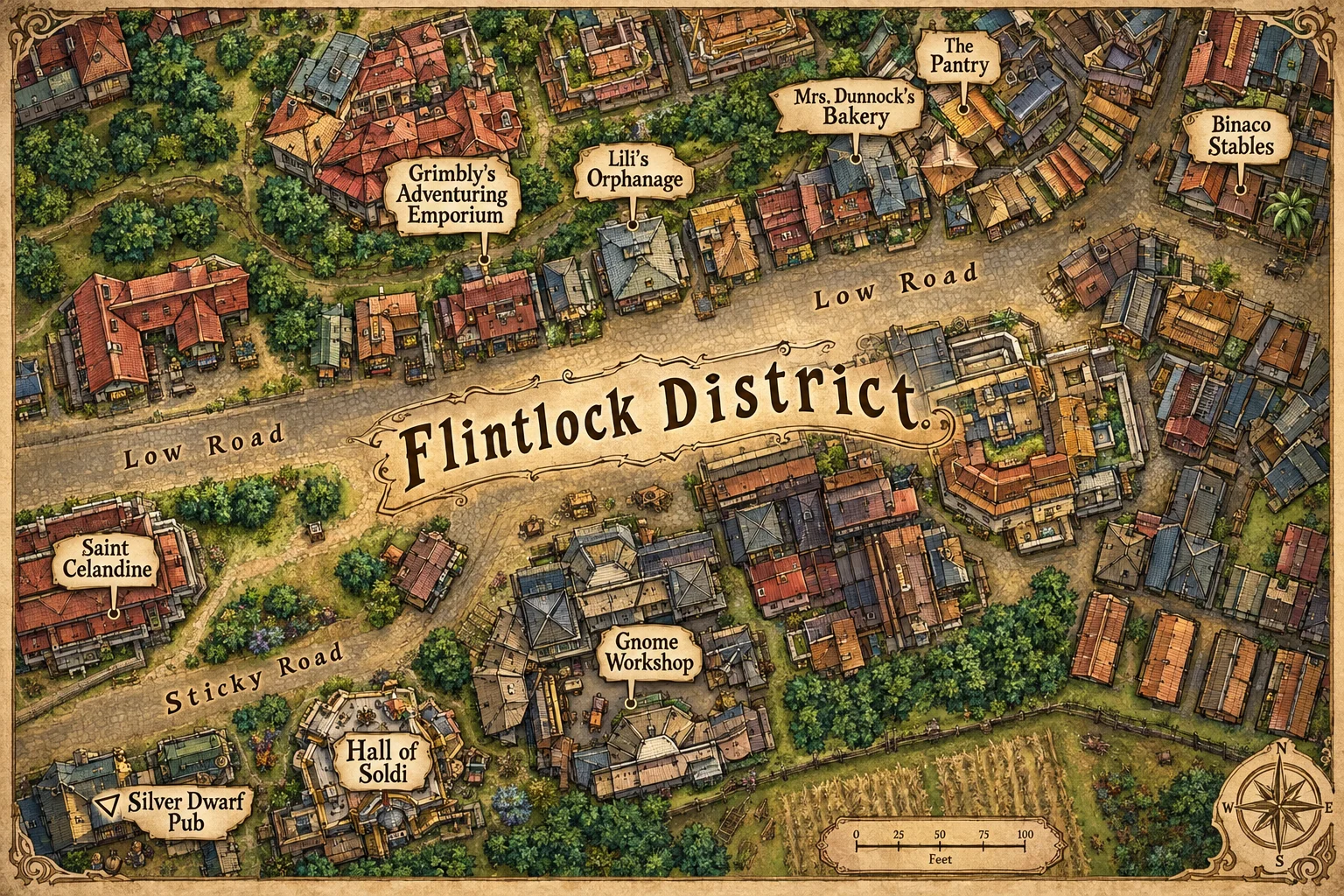 Flintlock District
The room over the kitchen was hardly more than a loft with a window. It was whitewashed; it had
The room over the kitchen was hardly more than a loft with a window. It was whitewashed; it had a narrow iron bed with a patchwork quilt, a desk, a chair, a shelf, a washstand with a jug; and it smelled wonderfully of bread, because the great oven below ran along the whole of the wall and sent up its warmth through the boards like a hand under a blanket. From the little window Ione could see the sloping tiles of the roof, grey-blue and whole, and beyond them, if she leaned, the Workshop's chimney, and a corner of the sky going rose over the Docks.
She sat down on the bed, with the satchel on her knee. The quilt was clean, and mended in six different colours.
You'll want a lamp, said Lili's voice at the door.
She had come up without a sound, as large women often do; she had an oil lamp in one hand and a cup in the other, and she put them both on the desk. "It's plum cordial," she said. "Cold. It's good for the nerves. You may as well be nervous in comfort." She looked down at Ione. "They'll test you. It's what they do. It isn't meant badly. Most of them were brought here by someone who left, and they like to find out early who'll go."
"I understand."
"Do you?" The grey eyes rested on her. It was not an unkind look, but it was a very straight one. "I don't ask," said Lili. "A person's business is her own. I'll say this once, and not again. You came to me out of a place where you were not well; I don't know what it was and I'll not ask. If it's a place you want to forget, there is nothing here that will remind you. Supper's at seven."
She went out. The stair creaked under her, one tread at a time, for a long way down.
Ione sat for a while with the cordial in her hands. It was pink, and sweet, and a little tart, and tasted of plums in a warm orchard in the sun; and when she had drunk it she found that her hands had stopped shaking, and that she was extraordinarily hungry.
At six on Earthstrong morning Lili put three coppers into Ione's hand and sent her down the road for the loaf.
"Mrs. Dunnock's," she said. "Three doors along, the one with the sheaf over the window. It's the Earthstrong loaf today, the heavy rye. Ask for it by name. She likes that."
The baker's shop was no wider than a corridor, and it was warm as a hand. Behind a scrubbed counter, among shelves of golden loaves and trays of buns, stood a very small, very upright woman of sixty in a white cap, with floury forearms folded across her bosom and a face as closed as a purse. She looked at Ione's collar. She looked at her shoes. Then she looked at the three coppers on the counter, and slowly, as a judge reaches for a sentence, she took down the biggest and darkest of the loaves, cut it with a single stroke of a long knife, and wrapped it in a cloth.
Ione noticed that she had cut it from the middle. The end, the crusty heel with its curl of black, stayed on the board, and Mrs. Dunnock laid a clean cloth over it with her own hand.
"I'm sorry," said Ione, "I think you've left out the end."
"I have."
"Might I have it?"
"No," said Mrs. Dunnock. She gave the word no weight, as one tells the time. "The end is for those who've earned it."
"I've paid."
"You've paid for the loaf." The small shut face did not alter. "Mr. Corbet asked for the end. Miss Anselm asked for the end. Miss Pomfret asked for it twice, and she lasted nine days. Come back when you've earned it."
"How will I know when?"
"I shall tell you," said Mrs. Dunnock, and turned to the oven.
The schoolroom, after breakfast, smelled of paint.
It had been the wash-house once, a long low square room off the passage behind the kitchen with a flagged floor and a copper in the corner, and the builders had taken out the copper and put in a stove. It was new and black and shining, with a brass rail, and it stood in the middle of the north wall like a cat. There was a window in the south wall that opened, and Ione opened it, and the sun came in on twenty new benches in rows. There was a teacher's desk on a low platform. And on the wall behind it, hung from two stout iron nails, there was a blackboard so new and so black that it seemed to have been cut out of the night.
She put her hand flat on it. It was cool, and very slightly rough, and ready.
On the teacher's desk stood a flat deal box, tied with string, and under the string a card. Inside the box, packed in straw, lay a stack of twelve new slates in wooden frames, each with a stub of slate-pencil on a thread. The card was written in a small, upright, clerkly hand that she knew at once, because she had watched it write down a great deal in a place of green fire: A dozen slates, guaranteed not to crack. With the compliments of the Stewards of Trusted Affairs. I.B. There was a postscript. The guarantee has been read and found sound.
Ione laughed, once, quite suddenly, in the empty room. Then she set the card on the desk, square to the edge, where she could see it.
"It's a good board," said a voice behind her.
It was Elise. She was standing in the door with a basket on her arm, a broad comfortable woman of about forty, with a pencil through her hair and a shawl pinned all over with bookmarks, and a smile that began at the dimples. "I'm Elise," she said. "I'm the storytime. I do twelve till two every day, and I'm told I'm to give you advice, so I may as well begin. Have you got a plan?"
"I have," said Ione. "It's nine pages."
"Ah," said Elise.
"Is that too long?"
"It's about nine pages too long. But we'll come to it." She set down the basket. "Come and hear the first story, and then we'll talk. It's the one about the baker's apprentice and the moon."
Ione went out into the passage with a faint sense of having been taken by the elbow, and hardly knew how it was done; and she stood in the kitchen doorway at noon, with her arms folded in the warm smell of onions, and listened.
It was an extraordinary thing to hear. The children sat on the floor in a heap, with their chins on their knees, twenty of them and a cat; and Elise sat on a stool with her pencil in her hair and told them the story of the baker's apprentice who stole a piece of the moon for the bread. She did not read it; she had no book. She did the voices. She did the baker, who was enormous, and the apprentice, who was thin, and the moon, who had a voice like a spoon in a pot of honey and a good deal to say about being eaten; and the twins held hands, and the thin silent boy forgot his candle, and Tobbin, who was five, climbed onto Ione's foot without noticing and went to sleep. It took forty minutes. At the end of it, nobody moved at all.
"There," said Elise, softly. "That's the whole of my secret."
"I don't see it."
"You wouldn't. You've just been trying to see it with your head." She patted the stool beside her. "A child doesn't learn what you tell her, my dear. She learns what you love. Out loud, where she can hear you. I love stories; so they love stories. They don't know a thing about it. They have simply caught me at it." She smiled at Ione's face. "What is it you love?"
"Grammar," said Ione.
She had said it before she thought, and her ears went hot. It was an absurd thing to say. She had said it to the examiner at the Academy; she had said it, in a faint, apologetic voice, to a tall man in a grey coat on a landing in the dark. It was a thing she had always said as one admits to a limp.
But Elise only clapped her hands together once, very softly, so as not to wake Tobbin.
"Marvellous," she said. "Nobody has ever loved it before. We'll have it all to ourselves."
By Firespark the plan had come down to a single page.
She sat at the desk in the loft, with the window open on the warm dusk and the oil lamp turned low, and looked at it. At the top it said LESSON ONE. Below it said, Introduction. Below that, in a hand that was not entirely hers, someone had written Gerund? and drawn a line under it twice. That was all. The other eight pages were in the stove. She had burned them one at a time on Earthstrong evening and had stood afterwards in the kitchen with the lid of the stove in her hand and a feeling of having been unexpectedly relieved of a very heavy hat.
What did I think I was doing?
She did not know. She had said yes in the sunshine on a step with twenty faces watching her and a man with a hat at her back, in a blaze of relief, because it had seemed a plain bright door out of a dark room. She had not thought of the day after. Now it was the day before the day after, and she was sitting alone at a desk in a house that smelled of bread, with a certificate, and a dozen new slates in a box, and nine fewer pages than she had had on Earthstrong, and she thought: they will see in a minute. They are not stupid. They have been looking at people all their lives to find out who is going to leave.
The stair creaked below her. She went to the door.
At the bottom of the flight, where the stair came into the kitchen passage, a small figure sat on the third step in the dark with his knees drawn up. It was the thin silent boy. He had his candle-jar beside him; the stub in it was lit now, a bead of gold in the glass, throwing a trembling circle on the plaster; and he looked up as she appeared, and did not say anything, and did not move away.
"Wick, isn't it?" said Ione.
He nodded.
"May I sit?"
He considered it. Then he moved up one inch, a very small and dignified inch, and she sat down on the step above his with her skirt tucked round her knees. They did not speak. Below them, through the half-open kitchen door, came the gentle sound of the stove ticking as it cooled and Lili moving about with a cloth; and above them the beams creaked; and in the glass the candle burned steady and small. She understood, after a minute, that he was not afraid of the dark. He was keeping it company.
After some time, he got up and went on up the stair to bed, with the jar held before him in both hands like a lantern; and Ione sat on in the half-dark, and breathed.
She found Lili in the kitchen. She was sitting at the scrubbed table with a mug of tea, in the lamplight, with her sleeves down for the first time that day and her great scrubbed hands folded round the cup, and in the soft low light she looked very tired and a good deal younger. She did not look up.
"There's tea in the pot," she said.
Ione poured herself a cup. She sat down across the table. The larder door stood behind Lili's shoulder, with its five lines of chalk and its empty yard beneath; and for some time the kitchen was quiet except for the small hissing of the lamp.
"I wasn't well," Ione said.
Lili turned her cup a quarter-turn on the wood.
"You said it on my first evening. You said I came out of a place where I was not well. It was a place where I'd gone to be looked at." The words came more easily than she had expected, in the plain bare voice of a person reading an entry in a ledger. "I thought it was what I wanted. There was a crowd; I stood in a white dress; and everyone looked. And the thing was, Mistress Lili, that I found that I was not in it. They were looking at someone who was standing there instead of me. I had thought that to be seen would be like being known. It was not. It was the loneliest thing that I have ever done." She drew a breath. "So I stopped. I'm telling you because I think you ought to know that I am not very sure what I am. I have only my grammar."
Lili said nothing for some while.
Then she lifted her eyes. They were as clear and grey as water, and there was nothing whatever in them of pity; it was a better thing than pity, it was the look of a woman who has seen forty children come in out of the rain.
"Then you've come to the right house," she said. "Nobody in this house looks at anybody. It's not how we do. We look with them." She finished her tea. "You'll find it's a different thing."
She got up, and rinsed the mug, and set it upside down on the board; and at the door she paused with her hand on the latch, and added in her flat, dry voice, "And for the Five's sake, Miss Fairlie, begin with something you can do."
When she had gone, Ione sat for a long time in the lamplight with the cold tea in front of her.
A gerund, she thought, is a verb that acts like a noun.
It was the one sentence in the world of which she was perfectly certain. She said it to herself, slowly, once more; and then she went up the stair to bed, past the third step where a ring of candle-wax was cooling on the tread, and lay awake for a long time in the smell of the bread, listening to the old house creak, and thinking about swimming.